Why put QR codes on packaging?
Your product packaging is the one marketing surface that reaches 100% of your customers. Every single person who buys your product holds the box, bag, or bottle in their hands. A QR code turns that moment into a digital interaction.
- Extended product info — ingredients, sourcing, care instructions, assembly guides
- Reorder and replenish — "Running low? Scan to reorder" is a one-tap repeat purchase
- Registration and warranty — replace paper warranty cards nobody fills out
- Reviews and social proof — "Love this? Scan to leave a review" captures customers at peak satisfaction
- Loyalty programs — scan to earn points, no plastic card needed
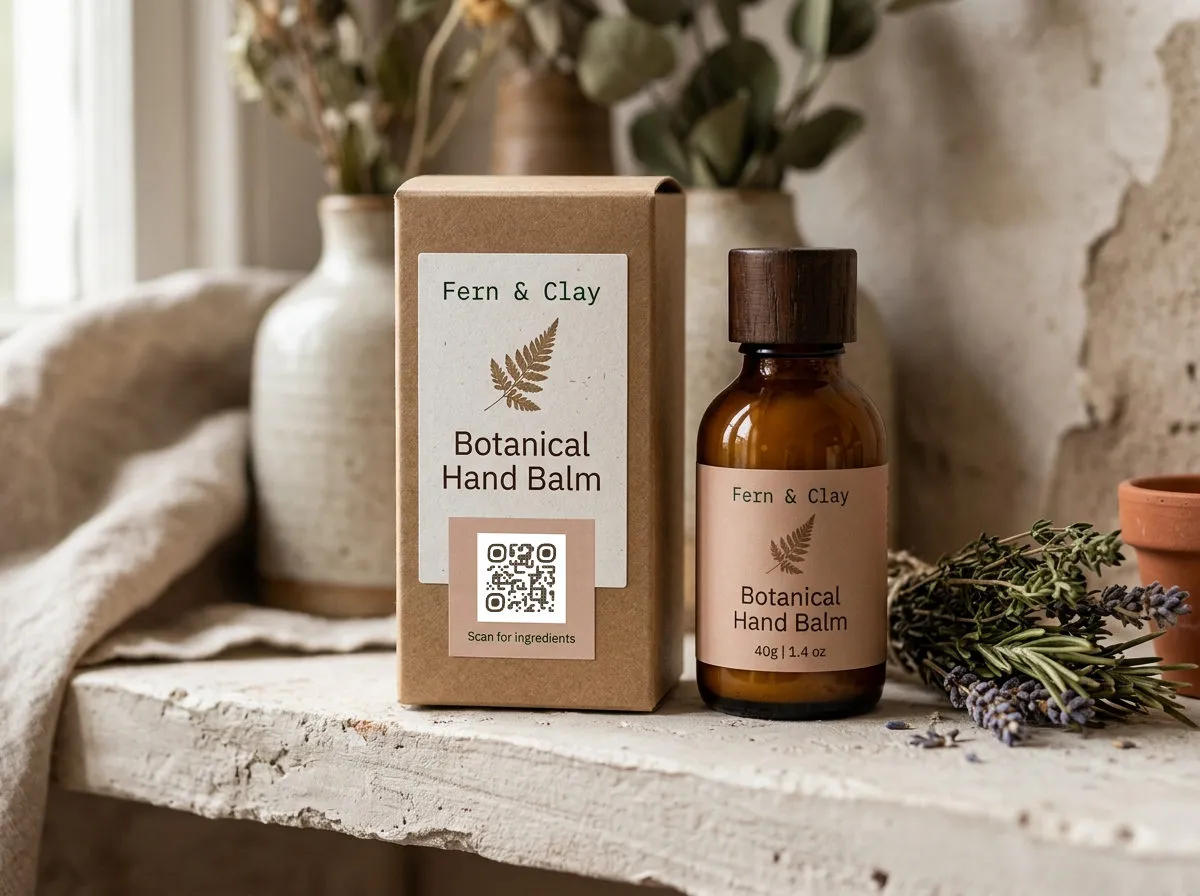
Sizing and placement
Packaging QR codes need to be at least 1.5 cm × 1.5 cm (about 0.6 inches) — and bigger is always better. They're scanned at arm's length in varying lighting, so err on the side of generous.
Where to place it
- Back panel: The most common spot. Near nutritional info, ingredients, or care instructions.
- Inside the lid or flap: A surprise moment. Good for unboxing experiences and loyalty programs.
- Hang tags: For apparel and accessories. The tag is already in the customer's hand.
- Sleeve or wrap: For bottles and cans, position the QR where it won't be covered by the customer's grip.
Material-specific challenges
Curved surfaces
Bottles, tubes, and cans distort the QR pattern. Print the code 10–15% larger than you would on a flat surface, and position it on the least curved area. Test on the actual container — flat proofs lie.
Transparent and metallic substrates
QR codes need a solid, opaque background. On clear labels or metallic packaging, print a white backing behind the code. Without it, the background shows through and kills readability.
Shrink wrap and flexible packaging
Shrink wrap can distort during application. Place the QR code in an area with minimal stretching — usually the center of a flat panel. Test after wrapping, not before.
Smart labels and regulatory use
In some industries, QR codes on packaging are now regulation, not marketing. Since December 2023, wine sold in the EU must carry ingredient and nutrition information (Regulation 2021/2117), and most producers meet the requirement with an on-label QR "e-label" instead of cramming the data into print. In the US, the USDA's bioengineered food disclosure standard explicitly lists a scannable digital link — in practice, a QR code — as an approved disclosure method.
Even where not required, a QR code that links to sourcing transparency, sustainability practices, or detailed product specs builds trust with increasingly information-hungry consumers.
Dynamic codes on packaging
Dynamic QR codes are especially valuable on packaging because packaging has the longest shelf life of any print material. A box of cereal might sit on a shelf for months. During that time, you can update the linked content — swap seasonal promotions, add recall notices, update instructions — without changing the physical package.
If your packaging links to a setup video or unboxing guide, the YouTube QR code generator builds a print-ready code from any YouTube link in seconds.